
Restoration
The studio’s expertise in restoration can be traced back to 1999, when Dominic entered into partnership with his former mentor, the conservator Lucinda Compton. During this formative period, he developed an in-depth knowledge of a wide range of highly specialised techniques, including Gilding, Tôle, Asian Lacquer, European Japanning, Papier Mâché, and Arte Povera, all of which continue to inform and underpin the work of the studio today.
As members of LAPADA, we are committed to ensuring that every restored piece retains the patina and character of age while being sensitively consolidated and made structurally sound. Our clients include some of the most established antique dealers, as well as private collectors, and we approach each commission on its own merits, with close attention to the object’s history, condition, and decorative significance.
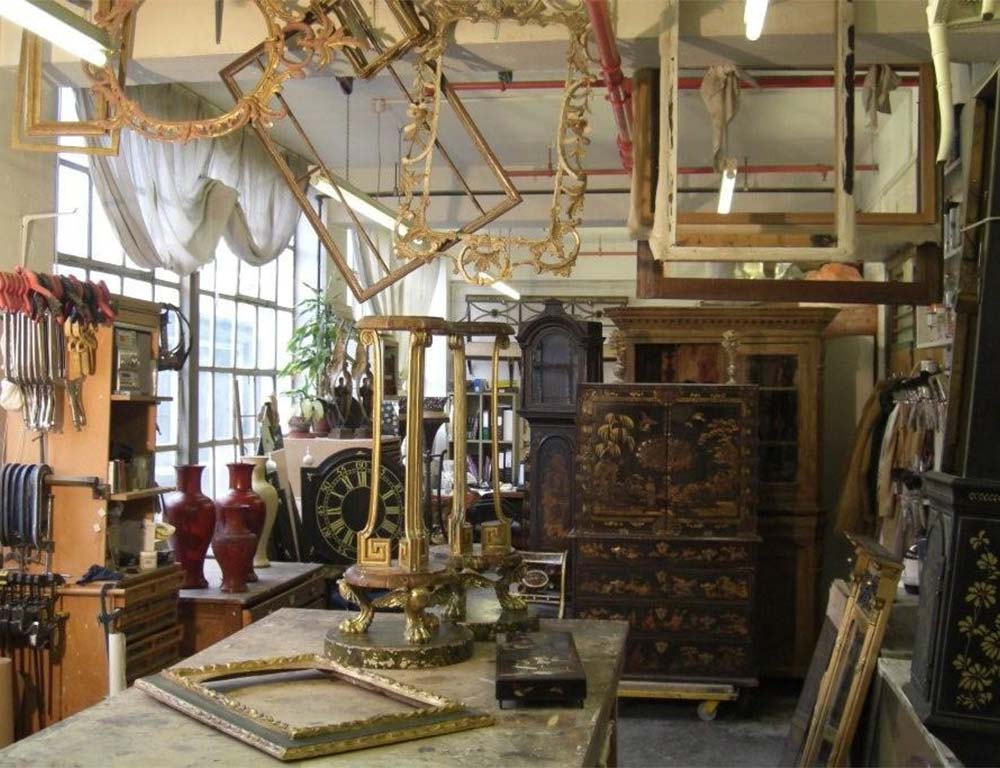
Restoration is possible on most pieces – and in many cases, virtually all. However, it is worth noting that restoration is not always the most appropriate course of action. In certain situations, a conservation approach may be preferable. Rather than restoring a piece to how it once looked, conservation focuses on stabilising and consolidating what already exists – preserving the current scheme, preventing further deterioration, and respecting the history and patina that the piece has accumulated over time.
Assessment can be carried out in stages. A good starting point is a set of detailed photographs sent to us by email, which will often allow us to give an initial indication of the work involved and a preliminary idea of cost. However, for more complex pieces, there is no substitute for a hands-on examination. In these cases, we would recommend bringing the piece into our workshop, where a thorough assessment – and any necessary tests – can be carried out in order to provide an accurate and considered quotation.